Guide
What Is AI Search?
AI search is when a tool like ChatGPT, Perplexity, or Google's AI Overviews reads across many sources and gives you one synthesized answer — often naming a few specific sources or businesses — instead of a list of links to click.
Updated September 2026 · ~6 min read
For twenty years, search meant typing a query and choosing from a page of blue links. That is changing fast. Today, hundreds of millions of people ask an AI a question and get a direct answer back — and increasingly, that answer names a single business as the one to use. This guide explains what AI search is, how it differs from traditional SEO, and what it takes to become the business AI recommends.
The major AI search engines
“AI search” (also called answer engines or generative engines) refers to several tools that all share the same behavior — answer, don't just list:
- ChatGPT & ChatGPT Search (OpenAI) — the most-used AI assistant; its search mode answers current questions and cites live sources. OpenAI reported roughly 800–900 million weekly active users in late 2025 to early 2026.
- Perplexity — an “answer engine” built search-first, where every answer leads with cited sources.
- Google AI Overviews & AI Mode — the AI summary above Google's results (now reaching 2+ billion users a month) and Google's full conversational search experience.
- Google Gemini — Google's standalone assistant and the model behind AI Mode and Overviews.
- Microsoft Copilot — Microsoft's assistant across Bing, Windows, and Microsoft 365, grounded in the Bing index.
- Claude (Anthropic) — a general-purpose assistant with web search, widely used for research.
How AI search is different from traditional SEO
The core shift is from a list of links to a single answer. Traditional search returns a ranked page and lets the user pick; AI search returns one synthesized response and frequently names a handful of sources or one recommended business inside it. That creates the “no-click” dynamic: because the answer is complete, people often never visit a website at all. By 2024–2025, roughly 60% of Google searches ended without a click (SparkToro/Datos), and Google's own AI Mode sessions are overwhelmingly zero-click.
So success stops being about ranking and starts being about being cited and recommended. If the AI doesn't name you, the customer never learns you exist — and nothing shows up in your analytics, because the search happened somewhere you can't see.
AEO vs. GEO — the two new disciplines
Two terms describe the work of showing up in AI answers, and they build on top of SEO rather than replacing it:
- AEO (Answer Engine Optimization) — structuring content so an engine can cleanly extract it and present it as a direct answer. Think: clear question-style headings, concise definitions, and structured data. Be the answer.
- GEO (Generative Engine Optimization) — shaping your content and wider web presence so LLMs reference, synthesize, and cite you. Think: authority, mentions across credible sources, and liftable evidence. Be trusted enough to be quoted.
Why it matters now
Adoption has moved from novelty to habit, and the buying journey has moved with it:
- Consumers: Adobe found about 39% of shoppers have used generative AI for online shopping and 53% use it for product research (2025).
- B2B: Gartner found 45% of B2B buyers used generative AI during a recent purchase (2025 survey).
- Conversion: multiple 2025–2026 studies find AI-referred visitors convert several times better than traditional organic — commonly cited around four to five times — because they arrive pre-qualified. (These are vendor benchmarks; exact multiples vary.)
Less traffic, but dramatically better traffic — flowing to whichever business the AI names.
How AI engines decide what to recommend
Being recommended isn't random. AI engines retrieve candidate passages from a search index and ground their answers in the most relevant, credible ones — so being crawlable and indexed (in Bing as well as Google, since Bing powers Copilot and ChatGPT search) is the price of entry. From there, two research-backed signals stand out:
- Answer-first, evidence-backed content gets cited more. A peer-reviewed Princeton study (KDD 2024) found that adding quotations, statistics, and citations can raise a page's visibility in generative answers by up to about 40%.
- Mentions beat backlinks. An Ahrefs study of ~75,000 brands found brand mentions across the web correlated with AI-search visibility roughly three times more strongly than backlinks — being talked about matters (correlation, not proven cause).
How to get your business recommended by AI
- Be technically retrievable — crawlable and indexed in Google and Bing; don't block the AI crawlers you want citing you.
- Write answer-first, structured content — lead with the direct answer, use question-style headings, add schema.
- Back claims with liftable evidence — real statistics, named sources, short quotable statements.
- Build off-site mentions — get named across credible third-party sources, reviews, roundups, and video.
- Strengthen entity clarity — a consistent name, description, and facts everywhere you appear.
- Keep it current, and measure the new surface — track AI referrals and how you appear across the engines.
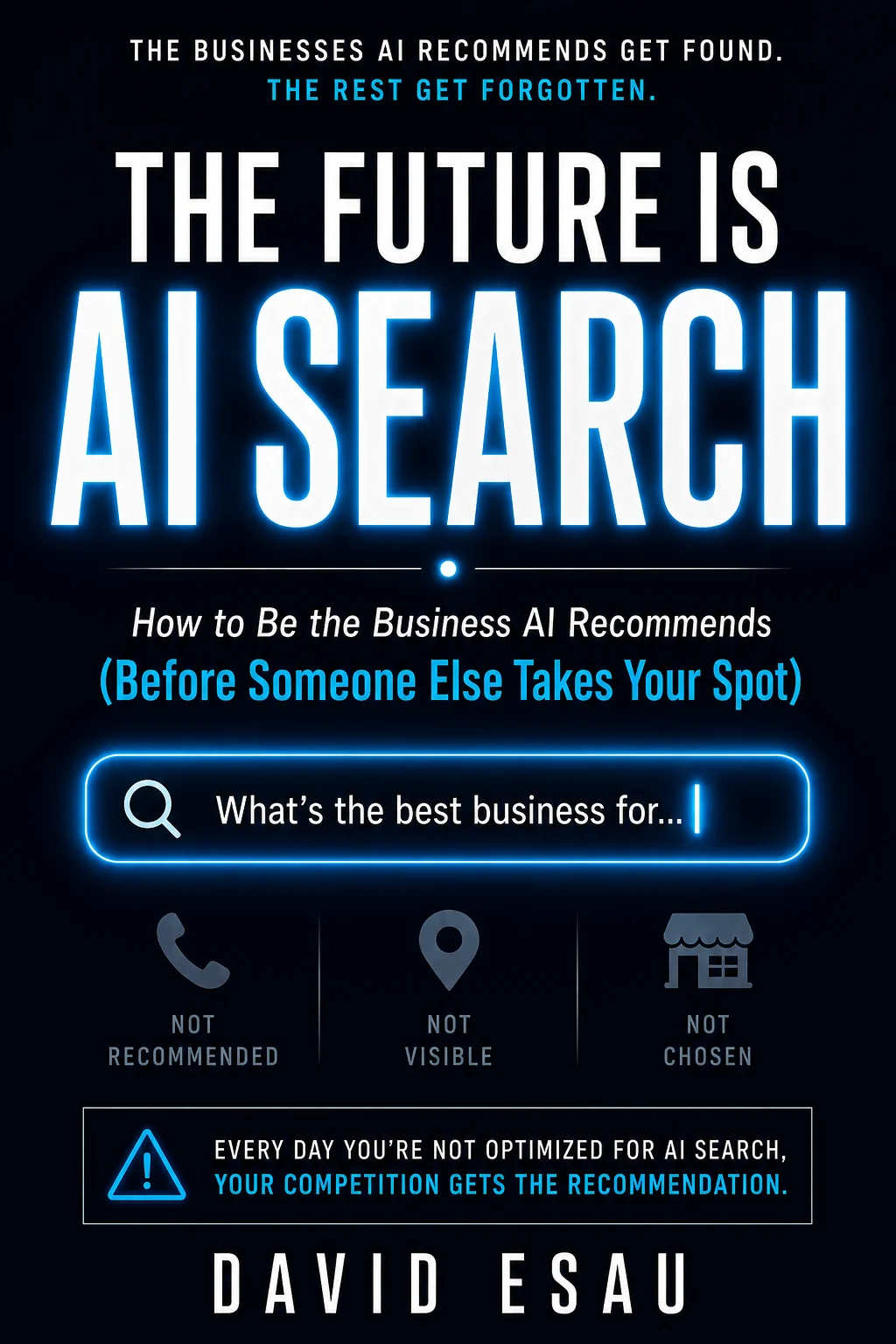
That, in a sentence, is what The Future Is AI Search is about — the complete, step-by-step system for becoming the business AI recommends in your market. If you want the deeper playbook, that's the book.
Frequently asked questions
What is AI search, and how is it different from Google?
AI search is when a large language model reads across many sources and returns one synthesized, conversational answer — usually naming a few sources or businesses — instead of a ranked list of links. Traditional Google search hands you ten blue links to choose from; AI search hands you the answer, and often a single recommended name. Tools like ChatGPT, Perplexity, Google's AI Overviews, Gemini, and Microsoft Copilot all work this way.
Will AI search kill SEO — do I still need it?
No, you still need SEO — AI search is built on top of it, not instead of it. To be cited in an AI answer, your content first has to be crawlable, indexed, and retrievable, which is exactly what technical SEO delivers. What changes is the goal: instead of ranking #1 on a page of links, you're trying to be one of the few sources the model pulls into its answer. AEO and GEO are the new layers that sit on a healthy SEO foundation.
What's the difference between AEO and GEO?
AEO (Answer Engine Optimization) is about being extractable as the answer — structuring content so an engine can cleanly lift a direct, self-contained response. GEO (Generative Engine Optimization) is about being credible enough to be cited into the answer — building authority and mentions across the web so LLMs reference you when they generate a response. A simple way to hold it: AEO = be the answer; GEO = be trusted enough to be quoted. They overlap heavily and both build on SEO.
How do I get my business recommended by ChatGPT?
To get recommended by ChatGPT, make your business easy for AI to read, trust, and cite: keep your site crawlable and indexed in both Google and Bing (Bing powers Copilot and ChatGPT search), write answer-first content backed by real statistics, and build consistent mentions of your business across credible third-party sources. Peer-reviewed research from Princeton found that adding cited statistics and quotations can raise a page's visibility in AI answers by up to about 40%.
How does ChatGPT or Perplexity decide which sources to cite?
AI engines first retrieve candidate passages from a search index, then ground their answer in the most relevant, credible ones — so being crawlable and retrievable is step one. Beyond that, they favor content that is answer-first and evidence-backed, and entities that appear consistently across many independent sources. An Ahrefs study of about 75,000 brands found that brand mentions across the web correlated with AI-search visibility roughly three times more strongly than backlinks did.
Is AI search traffic worth anything if people don't click?
Yes — even though roughly 60% of Google searches now end without a click, the visitors who do arrive from an AI-cited answer tend to convert much better because they come pre-qualified. Multiple 2025–2026 vendor studies put the conversion rate of AI-referred visitors several times higher than traditional organic — commonly cited around four to five times — though exact multiples vary by source and industry. The value is shifting from raw traffic toward being the name the AI recommends.
Do I need to do anything special to show up in Google's AI Overviews?
Google's AI Overviews draw from Google's regular index, so the fundamentals apply: be crawlable, answer the question directly and early on the page, use clear headings and structured data, and back claims with specifics. AI Overviews already reach more than two billion users a month, so appearing in them is increasingly where visibility lives — but you earn it through the same answer-first, authoritative content that AEO and GEO describe.
How do I track whether AI search is sending me customers?
Track AI referral traffic in GA4 (referrals from chatgpt.com, perplexity.ai, and similar), watch for lifts in branded search, and periodically ask the major engines your target questions to see whether — and how — your business appears. Because much AI activity is zero-click, also watch downstream signals like direct traffic and lead quality, not just referral counts.
Become the business AI recommends
The Future Is AI Search is the complete playbook — $25.00, free US shipping, $5 per copy to the AFSP.